
South Kesteven Design Code Draft
Chapter 1. Introduction
1.1 Overview
The purpose of this design code is to improve the quality of new development in South Kesteven.
The council is committed to ensuring that development, which we define as any new construction that requires planning permission, responds positively to the special natural and built qualities of our area. They should stand the test of time and be great places to live. They should improve existing places.
South Kesteven District Council has produced this design code primarily to assist and inform both applicants and officers involved in the design and development process, with a particular focus on ensuring that applicants for planning permission have applied the necessary consideration to their proposals.
The code outlines the Council's high design expectations and the steps to be undertaken in the design and planning process. This code will be a material consideration when determining planning applications.
This code should be read in conjunction with a range of national and local planning policy and design documents, listed in Section 1.5. This code is not intended to replicate guidance set out in those documents; it is to build upon and provide more detailed guidance about policies in the Local Plan.
The code has been prepared in accordance with the National Planning Policy Framework (NPPF) December 2024, the Town and Country Planning (Local Planning) (England) Regulations 2012. and The Councils’ Statements of Community Involvement. Stakeholder, Councillor, housebuilder and public workshops informed its drafting. Changes have been made following the extensive feedback received as part of a public consultation exercise.
Note that some developments do not require planning permission. This is called ‘permitted development’. As what constitutes permitted development is subject to change by Government, applicants are advised to check with the Council’s planning department.
1.2 Aims of the code
A design code is a recipe for a place. It presents a series of clear design requirements for new developments that influence and direct how they will function, look and feel within their surroundings. It should help applicants design and build new residential areas which feel of their place: new pieces of Lincolnshire rather than anywhere-places. It asks applicants to care about the places they create, to respect the neighbourhood and to value residents by building quality places that one would be proud to call home.
Sustainable principles run throughout the design code in ways that improve people’s everyday lives. They are not merely a ‘technical overlay’. Creating truly sustainable places means creating places that ‘pull us together’ by making it natural to walk and cycle as well as using cars, layering street trees and greenery throughout towns and villages and creating buildings that are of this place not of anyplace. This will encourage residents to love and maintain buildings for generations not pull them down at the first opportunity, thus creating communion between the past, the present and the future. By embedding true resilience and sustainability as core principles, the code encourages places that support human flourishing, ecological balance, and the collective well-being of communities, creating neighbourhoods that are not just sustainable, but beautiful, cherished and prosperous.
1.3 Code vision
Extensive engagement with local residents and stakeholders has been carried out for this Design Code. This design code vision reflects what we heard from the many engagement sessions and highlights the key priorities which the Design Code aims to strength and improve in South Kesteven.
- Sustainable development
Focus on sustainable designs, renewable energy and climate resilience, including solar panels, wildlife corridors and sustainable drainage.
- Greener communities
Embed trees, green spaces and green-blue infrastructure into all developments to enhance biodiversity, liveability and environmental sustainability.
- Community-centred design
Foster cohesion with accessible public spaces, village greens and shared amenities that encourage interaction and a strong sense of belonging.
- Controlled and sustainable growth
Limit development in small villages and rural areas, preserving their character, natural surroundings and landscape character and views.
- Supporting infrastructure
Ensure growth is matched by schools, healthcare, shops, transport and utilities to support thriving, well-connected communities.
- Transport and accessibility
Promote walking, wheeling, cycling and public transport while ensuring sufficient car and cycle parking.
- Preserve local character
Protect and enhance the distinct identity of towns, villages and hamlets by respecting local architecture, materials, heritage and landscape.
- Diverse and affordable housing
Provide a mix of affordable homes for all demographics, including starter homes, family houses, bungalows, social housing and accessible and adaptable homes.
- Future-proof development
Plan developments to be adaptable, sustainable and well-integrated with long-term community and environmental needs, high-speed broadband and electric vehicle infrastructure.
- Distinctive public realm
Prioritise high-quality, distinctive and green public places with locally inspired street art, street furniture and materials, with shops and services which reflect community needs.
1.4 How to use this code
The design code applies to applications of 10 or more homes (or non-residential developments of over 1000sq m floorspace). However, there may be occasions where it will help guide smaller developments as well. In many occasions using the code is likely to increase an applicant's chances of planning approval. It can also be applied where changes are made to streets or public spaces to ensure consistency between new and old places.
The code will also highlight differences in design approaches to be applied between area types. Further information about area types can be found in section 2. Context. Larger development schemes may include their own site-specific codes which provide bespoke detailed design.
These codes are an integral part of the development process and ensure that clear parameters are set for the implementation of the design strategy of South Kesteven District Council. It will be necessary for applicants to comply with all the specified codes.
These codes are intended to be objective wherever possible. It is inevitable that some difference of interpretation will arise. In all cases, common sense interpretations should be used but, if in doubt, South Kesteven District Council should be consulted in advance.
The code uses three levels of prescription.
MUST: Mandatory design practices. Developments that do not abide by them will not be permitted.
SHOULD: Design practices which are strongly encouraged due to the benefit that they will have for the neighbourhood. Where ‘should’ cannot be applied, justification will be required as part of a planning application and exceptions may be approved on a case-by-case basis, at the discretion of the council.
CAN: Design practices which are recommended but whose absence will not drastically affect the overall quality of the development.
The rationale behind the designation of MUST, SHOULD and CAN to elements of the design code is based on primary and secondary research into popular and healthy places as well as professional judgement and local community preferences.
Where policies are designated as a MUST, these are deemed to be essential and non-negotiable to “ensure that land is used efficiently while also creating beautiful and sustainable places” as required by paragraph 130 of the NPPF (December 2024) and through regulating relevant elements as set out in the NMDC.
1.4.1 Site scale
Throughout the code, reference is made to codes which apply to developments of various scales. These scales are:
- Medium: 10 to 49 homes
- Large: 50 to 299 homes
- Major: 300 plus. This category includes new settlements, major urban extensions and garden villages.
1.5 Relationship with key national and local documents
This Design Code must be read alongside key national and local documents.
1.5.1 National Design Guide
The National Design Guide illustrates how well-designed places that are beautiful, enduring and successful can be achieved in practice. It introduces ten characteristics and 29 related principles that are common to well-designed places. These are presented in the table on the next page, alongside brief consideration of how they may be applied in South Kesteven.
1.5.2 National Model Design Code
More detail on good design practice under the National Design Guide’s characteristics is provided in the National Model Design Code. Part 2: Guidance Notes is the most useful place to understand the Government’s detailed expectations on design outcomes.
1.5.3 Manual for Streets
The South Kesteven Local Plan stipulates that major development must demonstrate compliance with Manual for Streets, the Government’s guidance on how to design, construct, adopt and maintain new and existing residential streets. It promotes streets and wider development that avoid car dominated layouts but that do place the needs of pedestrians and cyclists first. The principles of the Manual for Streets permeate throughout the Design Code, particularly Chapter 4. Movement and Chapter 5. Public Space.
1.5.4 Building for a Healthy Life
The Building for a Healthy Life (BHL)(2020) toolkit is relevant to developments of 10 homes or more and sets out 12 questions to help guide discussions on planning applications and to help local planning authorities to assess the quality of proposed (and completed) developments. It can also provide useful prompts and questions for planning applicants to consider during the different stages of the design process.
The South Kesteven Local Plan expects new residential development to perform positively against the BHL criteria and performance is monitored.
1.5.5 National and local planning policy
Development needs to consider national and local level planning policy guidance as set out in
the following documents:
- National Planning Policy Framework (NPPF, December 2024);
- Planning Practice Guidance (PPG);
- South Kesteven District Council Local Plan (2020);
- Neighbourhood Plans;
- and subsequent planning and environmental legislation and guidance as it becomes available.
1.5.6 Conservation area appraisals
South Kesteven has 47 Conservation Area Appraisals which set out the special character of these areas based on the quality of their building, historic layout of roads and spaces, and particular materials and elements which contribute to its appearance. New development in any of these areas should refer to the relevant area appraisals.
1.5.7 Neighbourhood plans
A number of neighbourhood plans have been, or are being, prepared in South Kesteven. New development in those areas should be determined in accordance with the planning policies set out in those neighbourhood plans which are ‘made’ (i.e. adopted), unless material considerations indicate otherwise, as they are also used by the local planning authorities to determine planning applications. Neighbourhood plans often contain character assessments that describe what makes area distinct.
1.5.8 Lincolnshire County Council
Lincolnshire County Council is the local Highways authority. Further guidance, including Guidance for Developers, can be accessed at Development Road and Sustainable Drainage – Lincolnshire County Council.
1.6 The design process
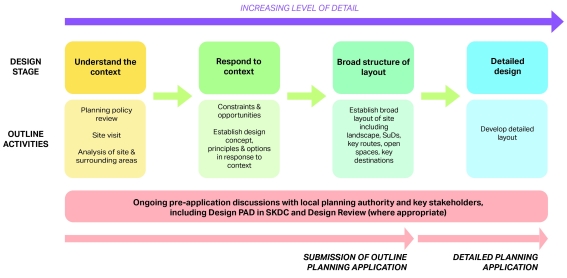
The design process should start with an understanding of the site in its broader context and work towards a more detailed proposal. The flow chart sets out the suggested steps of the design process.
Whilst the activities outlined are focussed on medium to larger applications, the process is similar for most scales of development. Chapter 2 of this Code sets out how the Councils expect planning applicants to analyse, interpret and respond to their site’s context, beginning with a planning policy review, site visit and analysis of the site and its surrounding area. Designers are then expected to identify the site’s key constraints and opportunities and in response to its context, establish a design concept, principles and explore options for the site. Following this, Chapters 3, 4, and 5 sets out the codes applicants must follow in developing a broad layout structure for the site, including key features, routes, public and green spaces, land uses and landscape elements.
Chapters 6 and 7 cover the relationship between buildings and buildings themselves, covering detailed design issues specific to South Kesteven for schemes of all sizes, and high-level principles for non-residential buildings as well.
Development proposals that have not followed the design process and that do not include a thorough site and contextual analysis (as specified in Chapter 2. Context), which do no demonstrate how they have responded to context and those that do not comply with this Design Code will be rejected/refused or delayed until this work is undertaken.
National advice on what should be submitted as part of a planning application, and what type of application you should apply for, is set out on the Planning Portal website.
1.6.1 Design, Planning and Drainage (Design PAD) and Design Review
Design PAD is a monthly review of planning proposals that aims to improve the design quality of new development and provide a more streamlined planning service by facilitating multidisciplinary discussions and feedback on development proposals.
The Design PAD sessions are chaired and documented with summary notes and the most appropriate team of professionals is selected for each proposed development scheme. The sessions commonly include the planning officer, design officer, highways and lead local flood authority, Internal Drainage Board, Anglian Water, with other disciplines such as heritage, landscape, affordable housing and environmental health attending as required. Developers and their team of professionals are invited to attend when appropriate and this is a very effective and efficient way for multidisciplinary discussions and feedback on proposed developments to take place, with developers coming away with more certainty and having progressed or resolved the more complex issues. The Design PAD service would form part of this process. Development schemes can appear at Design PAD multiple times as they are refined and improved. Both Outline, Full and Reserved Matters planning applications can also be assessed at Design PAD.
It is crucial that applicants demonstrate how they have followed the three steps in the box on the right in order. This will avoid wasted time and effort, and secure a better outcome for all parties. In addition to internal arrangements such as Design PAD at South Kesteven, significant developments (defined by the Council) will undergo an independent Design Review, ideally as early as possible in the design process, when it is felt that such a review is required.
The Council and the Applicant will be equally involved in the selection of a review panel. The cost associated with the Design Review will be covered, in full, by the Applicant.
Significant developments will be determined on a case by case basis, depending on the context of each individual site.
1.7 Engagement
The NPPF and National Model Design Code encourage much more extensive public engagement and involvement of neighbourhood plan groups and Town and Parish councils in design. Planning applications should demonstrate how the proposed design has been influenced by them.
The first reference point should be the Neighbourhood Plan, where one exists. Many of these contain policies on design and some include a design guide or code. The policies in a Neighbourhood Plan have the same weight as those in the Local Plan.
Depending on the scale of the proposed development and the sensitivity of the context, applicants may be expected to undertake bespoke community and stakeholder engagement. This will certainly be required for major applications. The Councils’ respective Statements of Community Involvement should be followed as they it sets out how the community, businesses and others with an interest in development can engage with the planning system.
This SPD Design Code does not stipulate how engagement takes place as it should be tailored to fit the situation.
Approaches could include:
- Co-design workshops: hands-on, interactive sessions led by skilled facilitators and designers, they are great for understanding context and generating design options;
- Exhibitions and public meetings: good for presenting ideas and collecting feedback;
- Online: good for reaching those who may not come to an event, but people need to be aware that the exercise is taking place, and can be supplemented by a dedicated website providing information on the proposal; and
- One to one meetings: these can be appropriate for householder and small infill applications to discuss proposals with neighbours before the application is submitted.
1.8 The design process
1.8.1 Pre-application Advice
For large applications or sites with complex issues, like drainage or heritage, pre-application discussions with statutory consultees or other agencies such as the Lead Local Flood Authority, Environment Agency, Greater Lincolnshire Nature Partnership, Anglian Water or Historic England should be undertaken so that they have the opportunity to shape proposals rather than just react to a submitted proposal. See details on Design PAD above. Planning Performance Agreements might also be used.
Pre-application discussions should take place before an outline planning application is submitted. The local authorities will not advise on and negotiate significant amendments to poor quality applications where no pre-application discussions were held.
Please follow the Pre-application advice and Guidance | South Kesteven District Council link for more information on pre-application advice and guidance.
Whichever approach is followed, the planning application should be clear on:
- Who has been engaged;
- How they have been engaged;
- What they said; and
- How the design has been influenced by the engagement.
1.8.2 References
The Government’s advice on effective community engagement on design stresses that “local planning authorities and applicants are encouraged to proactively engage an inclusive, diverse and representative sample of the community, so that their views can be taken into account in relation to design”. Please follow the Design: process and tools - GOV.UK guide for more information.
Refer to the Statement of Community Involvement for expectations on engagement in South Kesteven.
