
South Kesteven Design Code Draft
Chapter 6. Built Form
This section provides an overview of design principles to create development with a varied character. The design and setting of all new buildings, whether houses or commercial buildings, in towns or within villages, need careful consideration to reflect their context.
Getting the basic layout principles right, from day one, will be key to creating beautiful and popular places which residents and neighbours can love for generations. Designing new streets and places that are walkable, sustainable, attractive and inclusive places will enhance quality of life, promote economic vitality, and celebrate the built identity of South Kesteven.
6.0.0.01
Further detail on character is also available in the South Kesteven Character Assessment.
6.1 Development pattern
When designing a new development, it is important to consider how this responds to the local context and historic growth of a settlement. This will help the development sit within its context and better reflect an organic pattern of expansion rather than being 'tacked on' to a town or village.
6.1.0.01
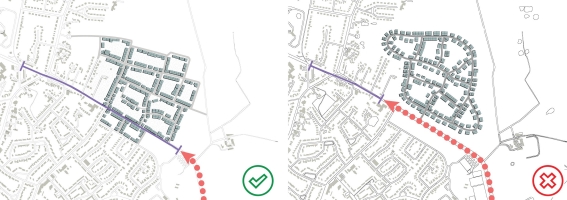
As set out in the Local Plan, Policy SP3: Infill Development is expected to be read in conjuction with and have regard to the advice below. This advice is also relevant to smaller developments (e.g.1 to 9 dwellings)
6.1.0.02
The character of new streets, even if only serving a small number of dwellings, is particularly important. New streets and driveways should be in keeping with the positive elements of the existing settlement’s character. For example, standard highways solutions used in a rural village may create a suburban character that is out of keeping with local street character.
The design of parking will need careful consideration, following the codes in the movement section, whilst also ensuring that the development can accommodate the parking needs of residents and their visitors and not overflow on to existing surrounding streets. Bin collection arrangements and locations will need careful thought and be sensitive to the existing settlement.
Development in rear gardens should not impact negatively on the amenity of adjacent properties and should be in keeping with the character of the area, including not eroding the character of surrounding streets, landscape features like existing trees and hedges or the urban form of the settlement.
The density of a scheme should reflect its context in terms of whether it is at the centre or edge of a town or village, or in a smaller settlement in the rural area. The optimum density will respond to surrounding densities whilst making efficient use of land, meaning that new development will usually be more likely to be higher than neighbouring areas.
The design of infill and small developments needs particular care and attention due to the often sensitive and characterful nature of the locations within which they are set. Infill and small developments have the potential to impact heavily on existing settlements and their residents. The design process becomes important to follow thoroughly, studying the local character and context comprehensively, responding sensitively to it and knitting new development into this context convincingly.
6.2 Urban design principles
B1: Development must:
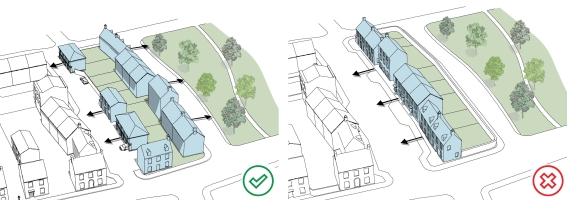
- Front onto existing streets, rather than back gardens fronting onto new or existing streets.
- Blocks must have clear backs and fronts, with back gardens facing other back gardens or parking areas. Back gardens which border communal green spaces or stretches of more than 2 back gardens will not be permitted.
6.2.0.02
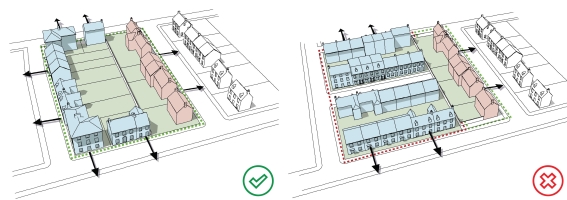
Where proposed development backs onto existing homes or development, it should 'complete the block.'
6.2.0.03
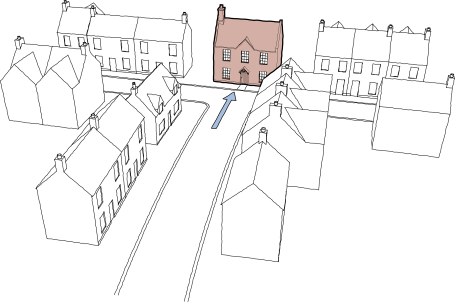
Buildings at the end of street vistas should be emphasised, as shown in the diagram. This should be in the form of higher architectural quality and/or higher quality materials or ornament and/or greater height. A vista could also be a landscape feature.
6.2.0.05
6.2.0.06
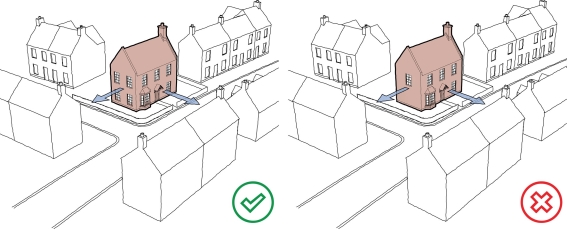
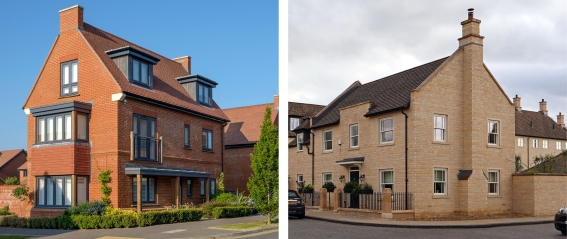
With regards to front gardens and front garden walls, the side elevation of a corner home should be considered as a "front" as well and include strong boundary treatment.
6.2.0.07
6.2.1 Building line
6.2.1.01
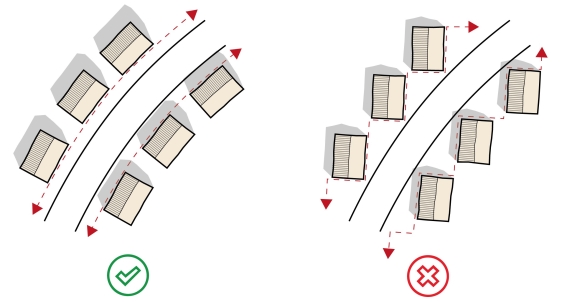
The building line should run parallel to the street. Buildings should not be turned at an angle to the street.
6.2.2 Building on a slope
6.2.2.01
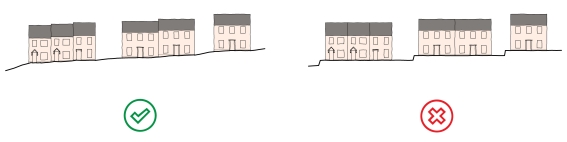
When building on a slope, a cut and fill approach with retaining walls should not be the default approach. Where technically feasible, buildings should follow the contour of the land, including attached homes.
6.3 Area Types
The standards apply area-wide or site-wide, not individual streets.
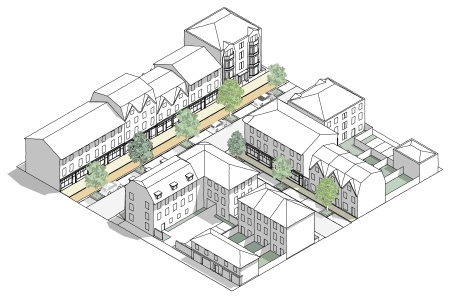
6.3.1 Town Centre Area Type
The Town Centre Area Type applies within the centres of Grantham, Bourne, Stamford and The Deepings (as defined by the Local Plan town centre maps) AND to a new mixed-use centre in major schemes of 300 homes or more. The character of this type is urban, with most buildings 2.5 to 3 storeys or taller, arranged in a dense urban pattern. All existing town centres overlap with Conservation Areas and Local Plan Heritage policy and Conservation Area Appraisals should also be followed.
B4: Town Centre Area Types must be designed to the following standards - (but must also respond to context and follow other code rules):
- Infill height: follow local context.
- Height in new developments: up to 4 storeys (subject to context)
- Net density: over 70 homes per hectare (dph)
- Built form: primarily flats and terraces with a high proportion of mixed-use buildings with active ground floor uses.
- Setback: no setbacks for buildings with ground floor active frontage; these buildings should front directly onto the pavement unless this conflicts with existing building line. Exceptions can be made for areas of outdoor dining. Residential-only blocks of flats or terraces can have setbacks up to 1.5m
- Building line: existing building line should be followed with no variance. It should be continuous with gaps between buildings only for service lanes or to account for changes between blocks of flats and other housing types.
- Parking: underground, podium, multi-storey, on-street and rear courtyard.
6.3.2 Local Centre Area Type
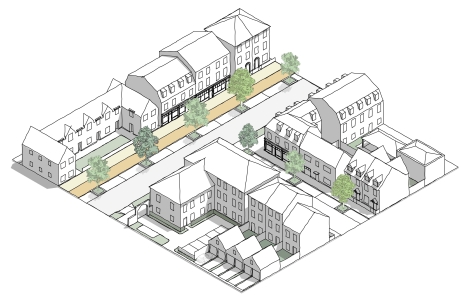
The Local Centre Area Type applies within existing local centres, village centres and high streets AND a local centre(s) will usually be required in large sites of 150 homes or more. The character is still urban, with primarily attached buildings, and height usually between 2 and 3 storeys. Most existing local centres overlap with Conservation Areas and Local Plan Heritage policy and Conservation Area Appraisals should also be followed.
B5: Local Centre Area Types must be designed to the following standards - (but must also respond to context and follow other code rules):
- Infill height: Follow local context.
- Height in new developments: up to 4 storeys
- Built form: flats, townhouses, and terraced homes with occasional semi-detached homes. Some active mixed-use ground floors.
- Setback: up to 1.5m; rural high streets could have greater setbacks (up to 2m)
- Building line: existing building line should be followed, with minor variance (+/- 0.5m) for a maximum of 10% of homes. Gaps between buildings must be minimised.
- Block size: no longer than 100m.
- Street design: street trees within build-outs or verge.
- Parking: on-street, rear courtyards, mews and peripheral parking
6.3.3 Urban Neighbourhood Area Type
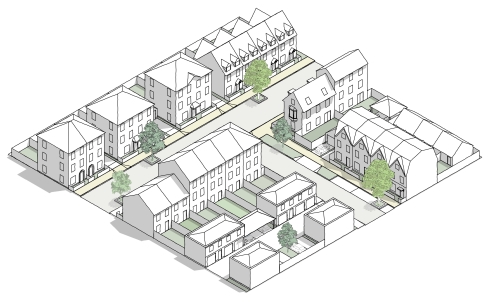
The Urban Neighbourhood Area Type applies within existing urban residential areas (usually Georgian or Victorian streets within existing towns) AND will usually be required in large-sized (50+ homes) urban extensions to existing towns. The character is urban yet green, with primarily terraces and semi-detached homes, and height usually between 2 and 3 storeys. Most existing urban neighbourhoods overlap with Conservation Areas and Local Plan Heritage policy and Conservation Area Appraisals should also be followed.
B6: Urban Neighbourhood Area Types must be designed to the following standards - (but must also respond to context and follow other code rules):
- Height: up to 3.5 storeys
- Net density: 40–50 dph
- Built form: a mix of flats, terraces, and semi-detached homes. Semi-detached homes should not exceed five in a row. Mixed-use on ground floor is permitted.
- Setback: 1-3m
- Building line: a consistent building line should be maintained, with variance of +/- 1m for a maximum of 10% of homes.
- Block size: no longer than 120m.
- Street design: street trees in build-outs and verge.
- Parking: on-street, on-plot (to the side), rear courtyard and mews.
6.3.4 Suburban Area Type
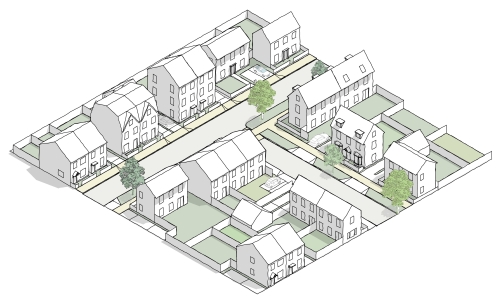
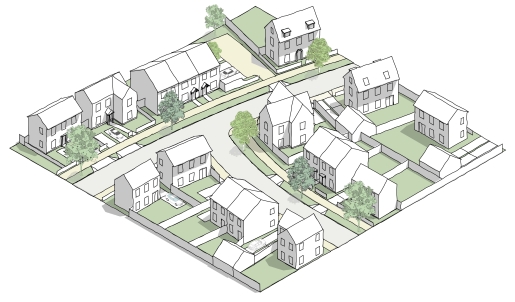
The Suburban Area Type applies within existing suburban areas AND is the most common Area Type in new developments of all scales. The character is semi-formal and green with a mix of house types, and height usually 2 to 2.5 storeys.
B7: Suburban Area Types must be designed to the following standards - (but must also respond to context and follow other code rules):
- Height: up to 3 storeys
- Net density: between 30–45 dph
- Built form: predominantly semi-detached and detached homes, with some terraces.
- Setback: varied setbacks between 2-6m to create a semi-formal streetscape.
- Building line: homes should generally comply with the building line, with variance of +/- 1m (or up to 6m on streets where front parking is permitted) for a maximum of 20% of homes.
- Block size: no longer than 150m.
- Street design: a softer character with street trees and some verges.
- Parking: on-plot (to the side and to the front), integral and detached garages, on-street, front or rear courtyard and mews. Front parking can be used for up to 10% of homes.
6.3.5 Village Area Type
The Village Area Type applies within existing villages and most new developments in rural areas. Occasionally it may also be applied to the edge of large developments (150+ homes). The character is informal and green with a mix of house types, and height usually 2 to 2.5 storeys.
B8: Village Area Types must be designed to the following standards - (but must also respond to context and follow other code rules):
- Height: 1.5 to 2.5 storeys and very occasionally feature landmark plots of 3 storeys
- Net density: 20-35 dph
- Built form: predominantly semi-detached and detached (with the rare terrace).
- Setback: usually modest setbacks (2-6m) with generous setbacks at development edges (up to 8m).
- Building line: a looser approach to the building line, with variance of +/- 1.5m for a maximum of 25% of homes or up to 8m when front parking is used.
- Block size: no longer than 180m.
- Street design: informal character with street trees, verges and gently curving streets.
- Parking: on-plot (to the side and to the front), integral and detached garages, on-street (informal), front or rear courtyards, mews and peripheral. Front parking can be used for up to 20% of homes but must be green in character.
6.4 Density
To create truly sustainable places which are walkable and cyclable, and deliver the homes we need, developments will need to shift towards a higher and more varied density to deliver a range of homes to meet local need, support mixed uses and make efficient use of precious land (thereby preserving more of the countryside). In essence our aim is a shift towards village and town building, not just 'housebuilding.'
The appropriate net density (measured in dwellings per hectare or dph) will vary depending on the Area Type, as specified in (6.3).
6.4.0.01
The reason for this requirement is to ensure a broad range of homes suitable for all ages and stages of life, from small starter flats to large family homes to downsized homes for later in life.
6.5 Amenity and separation
6.5.0.01
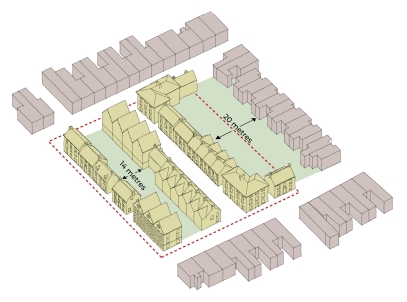
- Town Centre: 14m
- Local Centre: 14m
- Urban Neighbourhood: 14m
- Suburban: 16m
- Village: 20m
6.5.0.02
When proposed homes back onto existing properties, a minimum back to back separation between windows of 21m should be maintained. Lower distances may be acceptable where local precedence exists.
6.5.0.03
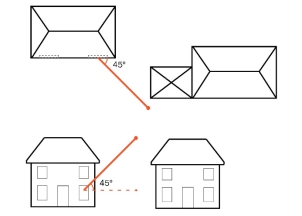
The ’45 degree rule’ states that there is normally the potential to achieve adequate levels of daylight and outlook when no part of a building cuts through a line radiating at 45 degrees from the centre of a window that lights a habitable room. Application will generally apply to front and rear single storey extensions which project 4m or more in depth and to two storey extensions which project 3m or more in depth.
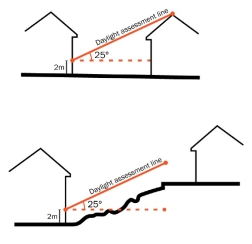
The '25 degree rule' states that there is normally the potential to achieve adequate levels of daylight and outlook when no facing building breaks a 25 degree angle from the horizontal from a point 2 metres above the floor level. This rule takes account of changes in level between buildings.
6.5.0.04
