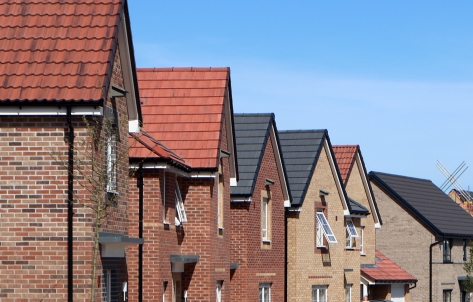
This chapter shifts attention to the individual building and considerations of architecture and detail.
The correct design response is influenced by a number of factors including the relationship between the site or extension and other buildings, routes and spaces, views and vistas, facilities, architectural details and landscape.
We do not advocate a specific architectural style but will expect all house designs to reflect the local character. You should study the appearance and architectural language of surrounding historical buildings to draw upon and influence designs.
There will be additional guidance for conservation areas and some parishes will have their own neighbourhood plans, design statements or codes which contain further detail.
7.1 Design principles
MUST
I1: For clarity, when reference is made to "reflecting the local area" or "locally prevalent," this refers to historical areas within the settlement. It does not make allowance for post-war or new-build precedents, with the exception of high quality context-led traditional and contemporary architecture. The character analysis must inform these decisions. Nearby examples of low quality design and materials that do not fit with the positive and predominant examples of local character that typify the area must not be replicated or used as an excuse for more low quality design and materials.
SHOULD
7.1.0.02
Development should not compromise the nature and character of settlements of any scale, including Grantham, Stamford, Bourne, the Deepings, Larger Villages and Smaller Villages, as set out in Local Plan Policy SP2. The nature and character of settlements is defined by I1 above and set out for Area Types in the South Kesteven character analysis (Appendix ?)
SHOULD
7.1.0.03
As set out in Local Plan Policy DE1, on sites of 10 dwellings or more, at least 10% of new homes should be ‘Accessible and Adaptable’ in line with Part M4(2) of the Building Regulations.
SHOULD
7.1.0.04
Affordable dwellings should be sensitively located with the aim of achieving sustainable communities that are intermixed, with affordable units being spread out and not being easily identifiable by means of a) design quality (including materials) b) style (including house types and architectural details) or c) location in terms of not placing affordable units in blatantly inferior locations.
SHOULD
7.1.0.05
Where one bedroom dwellings are provided as affordable housing within the development, there is a preference for these to be provided as terraced or semi-detached units that are more tenure-blind and benefit from private amenity space. If one bedroom units are provided as flats and quarter houses, it is important that these are well designed and every effort is made to integrate these within site layouts.
7.1.1 House types
MUST
I2: Developers' standard house and garage types must be adapted to their specific area by using local materials and architectural features that enable developments to sit comfortably within their contexts and reinforce local identity. Brick and stone wall materials, roof materials and front boundary treatments must match those typical of the local area. On a stone house, reconstituted or cast stone must not be used either for walls or any details. Contemporary designs are encouraged but must also reinforce local identity and sit comfortably, for example by using local or contextually responsive materials.
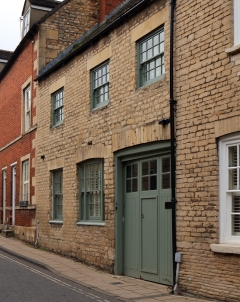
Fig 7.1: An example of a small home in Stamford which could be used as a reference for a mews house.
7.1.2 Design and proportions
SHOULD
7.1.2.01
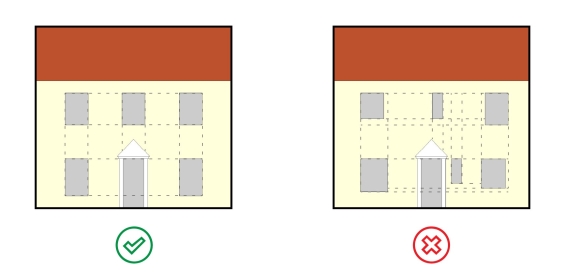
The size, type and spacing of window and door openings is crucial. A house should not have a random, haphazard series of openings.
Fig 7.2: A house must not have a random, haphazard series of window openings.
SHOULD
7.1.2.02
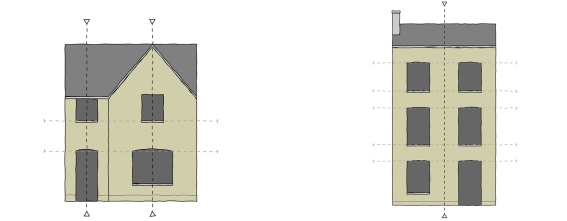
Facades of houses should aim for symmetry either as a whole or within individual elements of the façade, as demonstrated below. The top or bottom of windows should align as shown in the diagram below. Ground floor windows should align with the door or with a fanlight, canopy/porch, lintel or an ornamental element such as string course. The exception are semi-circular fanlights, which do not have to align.
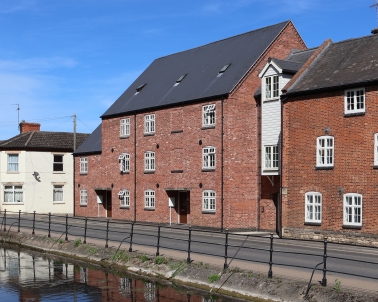
Fig 7.3: The top or bottom of windows should align and house facades should aim for symmetry either as a whole or within individual elements of the façade.Fig 7.4: An example of a new block of flats in Bourne which reflects the materials, windows and form typical of surrounding historical precedents
SHOULD
7.1.2.03
Where a development includes multiple wall and roof materials, these materials should be clustered, rather than changing arbitrarily, and should relate to the hierarchy of streets and spaces and local context.
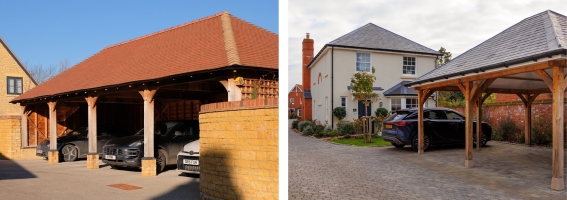
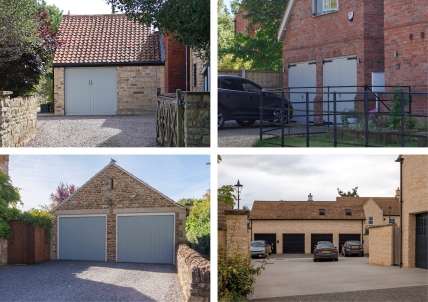
Fig 7.5: An example where both wall and roof materials vary arbitrarily, even though the house types are the same.Fig 7.6: Examples of acceptable carportsFig 7.7: Examples of acceptable garages
7.2 Materials
A building's materials are a crucial element to reflecting local character and fitting in to the existing context.
7.2.1 Wall materials
MUST
I3: Homes must use the following as their primary wall material in a proportion similar to the local historical context (see below for exceptions, such as for larger developents where buff/cream bricks can be used instead of limestone away from feature areas):
Limestone (ideally locally quarried)
Ironstone (ideally locally quarried)
Red/orange brick
Buff/cream brick
Painted brick
Roughcast or smooth render
Timber weatherboard (Village Area Type only)
Not all these choices will be permitted throughout the District. The permitted materials should only be used if already historically present in the adjoining settlement. The character analysis should be used as a guide for appropriate materials in a given area. Different guidance may exist in Conservation Areas.
SHOULD
7.2.1.02
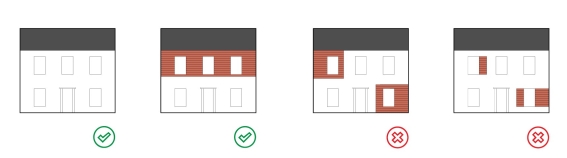
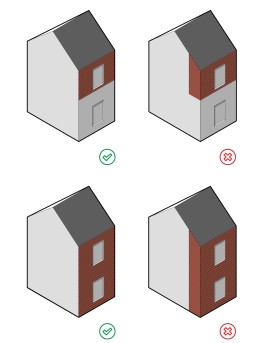
Materials should be arranged coherently, without random contrasting panels or material inserts, as per the diagram. When materials turn the corner, they should not end haphazardly, as per the diagram below.
Fig 7.8: Materials must be coherent, not arbitrarily arrangedFig 7.9: When materials turn the corner, they must not end haphazardly
CAN
7.2.1.03
An individual home can use a combination of two materials if that combination is found locally. For example, a home can have a stone front elevation and colour-matching render on the side and rear elevations.
7.2.2 Bricks
SHOULD
7.2.2.01
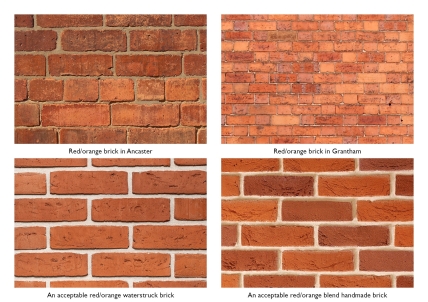
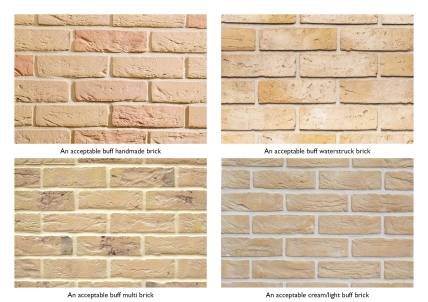
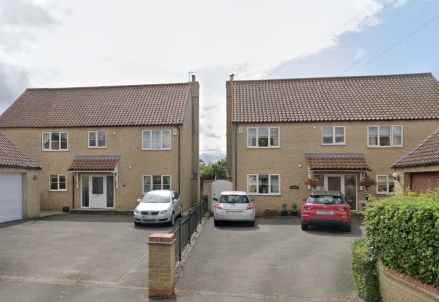
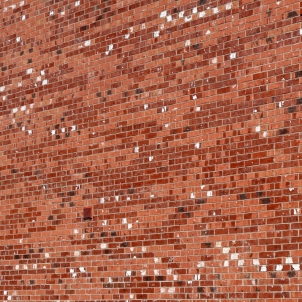
Bricks should match the traditional red/orange or buff/cream brick typical of their local area, for example as per the material palettes below. The aim of buff and cream bricks is either to match the local buff bricks or to match the tone of the local limestone.
Fig 7.10: Permitted red/orange brick palette
Fig 7.11: Permitted buff and cream brick palette
Fig 7.12: Examples of cream brick houses which successfully mimic the tone of the local limestone
SHOULD
7.2.2.02
Brick walls should use one primary tone of bricks. Artificially weathered or distressed bricks, bricks with black spots, or incoherent brick patterns using multiple colours, should not be used.
Fig 7.13: An example of a wall with an unnecessary and inappropriate variety of tones and artificially distressed bricks
7.2.3 Brick details
SHOULD
7.2.3.01
Brick homes should feature brick, stone or reconstituted stone lintels and cills.
SHOULD
7.2.3.02
Corbels, dentils and other projecting brick features or recesses should project a minimum of 25mm.
7.2.4 Render and painted brick
SHOULD
7.2.4.01
Render should be roughcast or wood-floated to ensure it's not too exact a finish.
SHOULD
7.2.4.02
Render colour should be white, off-white, cream or a subdued pastel colour as found locally.
SHOULD
7.2.4.03
Painted brick should be off-white, cream or a subdued pastel colour as found locally.
7.2.5 Stone
SHOULD
7.2.5.01
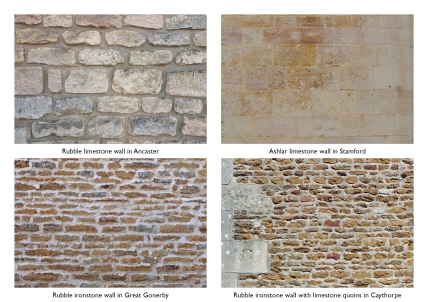
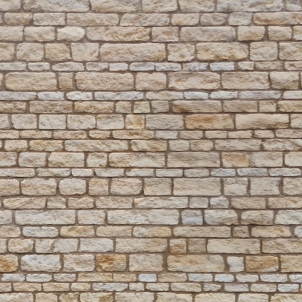
The colour of limestone or ironstone should match historical local examples.
Fig 7.14: Examples of local limestone and ironstone walls
SHOULD
7.2.5.02
The colour of mortar for stonework should match the colour of the stone or be a lighter tone than the stone itself.
Fig 7.15: An example of inappropriate mortar which is too dark in tone
SHOULD
7.2.5.03
Stone houses should have a recognisable stone lintel. In the Village Area Type, stone houses can have stone or timber lintels.
7.3 Roofs
7.3.1 Roof design principles
The shape and material of roofs contribute to defining the character of a building.
SHOULD
7.3.1.01
The form, pitch, overhang and appearance of roofs are an important determinant of character. The primary pitch, form and materials should reflect what is historically found within the existing settlement. Whilst some variety can add character, generally roofscapes should be kept simple.
7.3.2 Roof materials
SHOULD
7.3.2.01
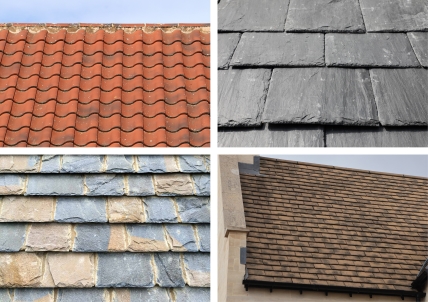
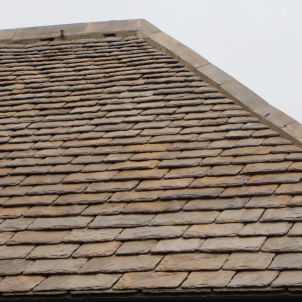
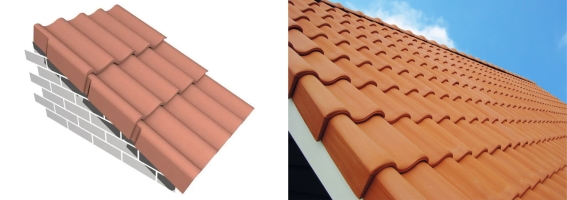
Roofs should be one of the following materials, and in a proportion similar to the local historical context:
Clay pantiles in red or orange
Slate
Collywestone slate
Clay tiles
In most areas, clay pantiles will be the most common choice, with smaller proportions of the other choices.
When imitation materials are used (such as reconstructed stone or glassfibre reinforced concrete), these should be nearly indiscernible from the natural material and must be of a single tone or natural range of tones across the roof and throughout the development. The tile size should should reflect local examples with large format and thick tiles avoided.
Fig 7.16: Examples of permitted roof materials
Fig 7.17: An example of acceptable imitation stone tiles
CAN
7.3.2.02
Flat roofs can be designed as green roofs. Green roofs offer multiple benefits such as absorption of rainwater, insulation, wildlife habitat, mitigating the heat island effect and providing an aesthetically pleasing landscape.
7.4 Windows
Windows in a variety of styles and materials can be found throughout the District. This code provides a range of window options that are readily available on the market and provides options for meeting the latest building regulations in a way which is not detrimental to design and quality of life.
7.4.1 Design principles
SHOULD
7.4.1.01
Windows should be recessed into the wall of the building by at least 65mm.
7.4.2 Window details
SHOULD
7.4.2.01
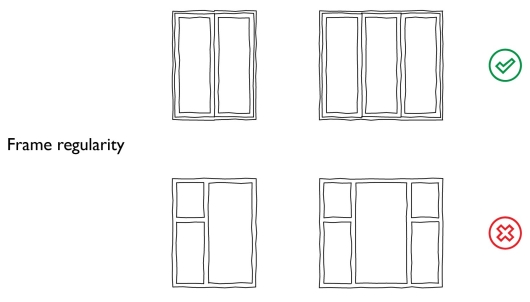
Windows should have regular panes, not an incoherent mix of taller and shorter or wider and narrower panes.
Fig 7.18: Windows should have regular panes
SHOULD
7.4.2.02
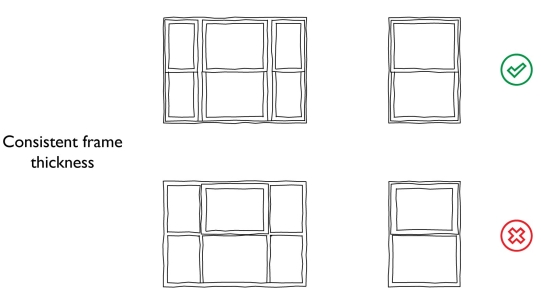
Windows should have consistent frame thicknesses, such that it is not obvious which part is openable and which is not.
Fig 7.19: Windows should have consistent frame thicknesses
7.4.3 Window types
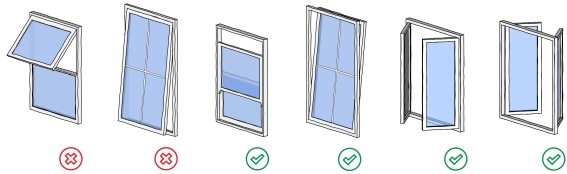
Fig 7.20: Examples of acceptable and unacceptable window opening types
CAN
7.4.3.01
Small secondary windows can be top-hung casement.
CAN
7.4.3.02
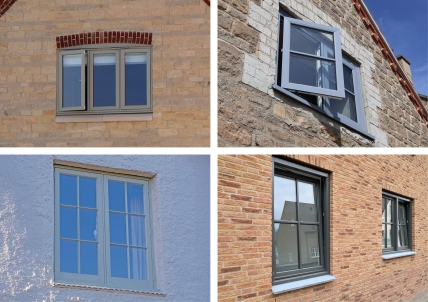
Side-hung casement windows can have a tilt-turn function to open inwards. Windows which open at the top are better able to vent hot air outwards.
Fig 7.21: Examples of acceptable casement windows with flush construction
7.4.4 Guard height and Part O Building Regulations
Part O Building Regulations have made window design more difficult and run the risk of leading to smaller, squat windows. These codes are aimed at preventing poor quality windows, ensuring windows which meet the regulations but still provide sufficient light to rooms.
SHOULD
7.4.4.01
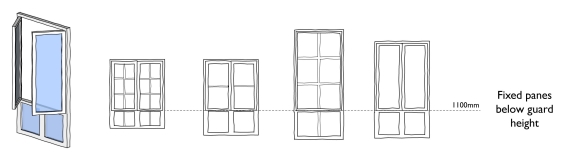
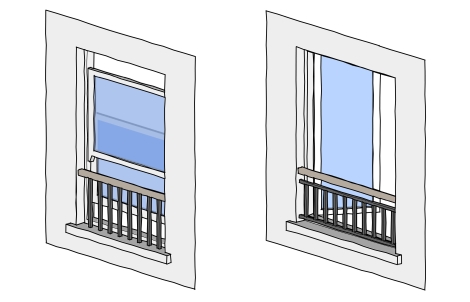
Where a window would otherwise be too small, a fixed lower pane or balustrade/railings must be used to allow for glazing below 1100mm. Low, squat windows should not be used.
Fig 7.22: Examples of windows with fixed lower panes, allowing for glazing below the 1100mm guard height
SHOULD
7.4.4.02
External window railings should be natural finish or painted timber or metal in white, black, or a colour matching the windows.
Fig 7.23: Examples of railings which allow for glazing below the 1100mm guard height
7.5 Building details and build quality
It is important that build quality, materials and architectural detailing make a positive contribution to local distinctiveness, vernacular and character. Quality materials and architectural detailing are expected.
SHOULD
7.5.0.01
Contemporary architecture should not be an excuse for lower standards of design or build quality, for example in the choice of materials, the inclusion of drip details or high quality windows.
7.5.1 Porches, canopies and door surrounds
SHOULD
7.5.1.01
Porches, canopies and door surrounds will not feature on all buildings, but where they do, they should be constructed from timber, brick, stone, reconstituted or cast stone or painted metal.
7.5.2 Verges
SHOULD
7.5.2.01
Wet verges should be used to better align with the local identity.
SHOULD
7.5.2.02
Where a cloaked verge system is used for roofs, cloaking tiles should be of the same material as the roof tiles, not plastic.
Fig 7.24: Examples of concrete and clay tile cloaked verges
7.5.3 Window details
SHOULD
7.5.3.01
All street-facing windows or doors with a width greater than 300mm must have visible lintels, except where the eaves, a cornice, or window or door surround conceal the space above.
SHOULD
7.5.3.02
Stub sills should be used on windows, to ensure that they don’t project over stone or chamfered brick sill features and look unsightly
7.5.4 Miscellaneous details
SHOULD
7.5.4.01
External glass balustrades should not be used in the Suburban and Village Area Types.
7.5.5 Meter boxes
SHOULD
7.5.5.01
On detached or semi-detached houses, meter boxes should not be mounted on the street-facing elevation.
SHOULD
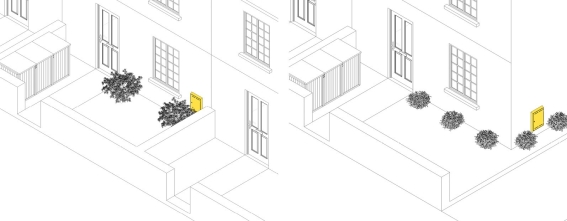
7.5.5.02
Ground level meter boxes should be used and they should be concealed behind a bin store or by planting. In a terrace, ground level meter boxes should be sited as far as possible from the front door.
Fig 7.25: Appropriate locations for meter boxes
7.6 Walls and fences
Boundary treatments play an important role in settling a new building into its street.
SHOULD
7.6.0.01
There should be clear delineation between public and private spaces at the front and rear of buildings (e.g. through boundary treatments or change of material). Private space to the rear should be enclosed.
SHOULD
7.6.0.02
Front garden wall requirements by Area Type (excluding when setback less than 1m): - Town Centre: 100% of homes - Local Centre: 100% of homes - Urban Neighbourhood: 90% of homes - Suburban: 70% of homes - Village: 50% of homes
Generally, homes along primary and secondary streets and along green and feature spaces will have a higher proportion of front garden walls, while homes along low traffic streets and the edges of a development should have a lower proportion.
MUST
7.6.0.03
I4: The choice of material for boundary treatments and walls must reference those found in the area and be used in a similar proportion to what is found in the historical settlement. Variation may occur, such as stone walls in the historic core and hedges on the rural edges of a village. Solid front boundary treatments must be used along primary streets and to enhance feature spaces and can be supplmented by a hedge behind.
Closeboard and concrete post-and-plinth fencing must not be used as a street-facing boundary treatment.
SHOULD
7.6.0.04
Permitted materials for boundary walls and front garden walls:
Local limestone or ironstone
Brick
Painted metal railings (alone or in combination with the above)
Hedges (alone or in combination with walls or railings)
SHOULD
7.6.0.05
When brick or stone are used for boundary walls and front garden walls, the material must be the same as used for the home.
SHOULD
7.6.0.06
Gates should be timber or painted metal.
SHOULD
7.6.0.07
Brick walls should use coping stones or coping bricks.
SHOULD
7.6.0.08
With regards to front gardens and front garden walls, the side elevation of a corner home should be considered as a "front" as well.
CAN
7.6.0.09
Closeboard fencing can be used in private service alleys / ginnels or as a boundary between back gardens.
7.6.1 Commercial boundary treatment
SHOULD
7.6.1.01
In commercial buildings, security fences should be screened by planting.
7.7 Sustainable buildings
Sustainable building design plays a critical role in addressing climate change, reducing resource consumption, and ensuring long-term resilience in new housing developments. Housing developments are expected to minimise carbon emissions, maximise energy and water efficiency, and incorporate durable materials and detailing.
As set out in Local Plan Policy SB1 e) Non-domestic buildings will be expected to be designed to achieve a minimum environmental performance BREEAM rating of 'Good.'
SHOULD
7.7.0.01
Sustainable design should not just consider an individual building in isolation but take a more holistic approach which considers layout. New development should be designed as mixed-use places which encourage walking and cycling and with easily accessible links to public transport to ensure we create more sustainable, equitable places.
SHOULD
7.7.0.02
New development should minimise the need for energy and water consumption, encourage recycling, minimise waste, and use sustainable construction methods.
SHOULD
7.7.0.03
Buildings should be designed and built to last, constructed from durable materials and detailed in such a way to resist premature degradation. For example, design details such as string courses, cornices and drip details are not just 'nice to haves' but solutions to the unavoidable effects of time and weather.
SHOULD
7.7.0.04
As far as street and block layout permits, the orientation of buildings should be considered at the onset of site planning to balance adequate passive solar gain in the winter with the impact of solar gain in the summer. Orientation can also be used to optimise the natural ventilation of a building or group of buildings.
7.7.1 Solar panels
SHOULD
7.7.1.01
Particular care should be taken when installing solar panels in conservation areas or in the setting of listed buildings. This must be discussed with conservation officers beforehand.
SHOULD
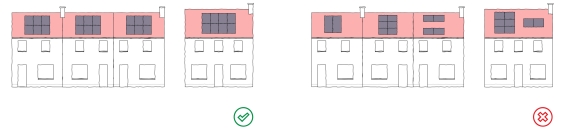
7.7.1.02
Solar panels should be installed on all new buildings and should be installed in a way which is not visually obtrusive per the diagram.
Fig 7.26: Appropriate and inappropriate placement of solar panels
CAN
7.7.1.03
In sensitive locations, solar tiles that are made to look like traditional roof tiles can be used. The best kinds are nearly indiscernible from traditional roof materials.
7.7.2 Heat pumps
SHOULD
7.7.2.01
Heat pumps should be sited to the rear or side of properties and should not be visible from the street.
7.7.3 Shutters and awnings
CAN
7.7.3.01
As summers in England get hotter, designing buildings which do not overheat will become an increasing priority. The following options, though not traditionally common in the area, can be used to address overheating.
Timber shutters
Awnings or brise soleils in a style and materials appropriate to the building (no plastic and no unpainted metal)
Deep eaves
Please add any further comments here
For instructions on how to use the system and make comments, please see our help guide.