
South Kesteven Design Code Draft
Chapter 4. Movement
Movement is how we get around within and between our towns and villages. Just like buildings, new streets should reflect the character of their area and feel like extensions to existing places. This character will be different depending on where the street sits in the street hierarchy and its context and location.
The majority of the public realm within our towns and villages is formed by streets. Their design therefore has a significant impact on new places’ quality and character.
As set out in the Local Plan, polict DE1, 'All major development (as defined in the Glossary) must demonstrate compliance with: h. Manual for Streets guidance and relevant Lincolnshire County Council guidance' but this section provides additional detail and principles which focus on the design of places.
South Kesteven is in a privileged position compared to many other authorities. Lincolnshire County Council is an exceptional Highways Authority dedicated to Manual for Streets principles and with low or no commuted sums for many elements.
This means that we have high expectations for exceptional street design and expect to see these elements included in schemes:
- Street trees;
- Swales;
- Raised crossings and Copenhagen crossings;
- Permeable and block paving;
- Tight corner radii;
- Edge lanes; and
- Shared surface streets.
4.1 Street network
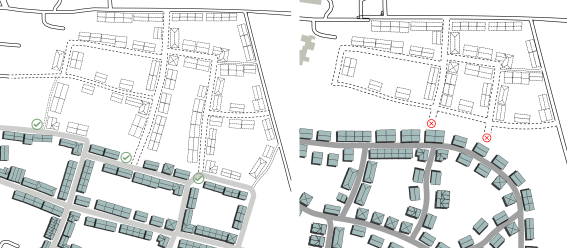
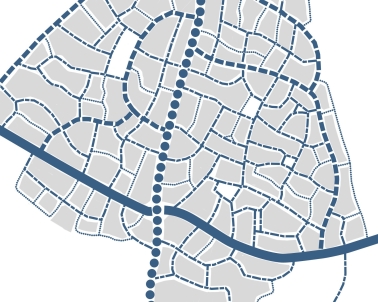
The street network is how our streets are laid out and interconnect. It is important because it can help or hinder how people travel around. In most cases, the street network will outlive the buildings it originally served. A well-connected street network provides a variety of routes for moving around.
4.1.0.02
4.1.0.03
4.1.0.04

4.2 Street hierarchy
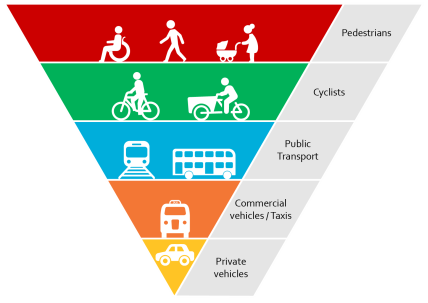
Streets must be designed according to the following hierarchy of users. This Design Code is aimed at achieving this aim with the explicit aim of creating places which put people first.
4.2.1 Street Typologies
4.2.1.01
The primary street will usually be the primary access route into a development. It should feature:
- Roadside swales
- Trees on both sides of the street
- No front parking to preserve the building line
- Strong front boundary treatments such as railings and walls
- Integrated on street visitor parking where possible
4.2.1.02
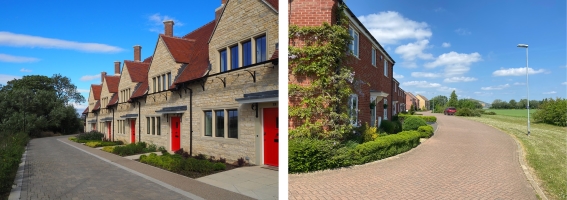
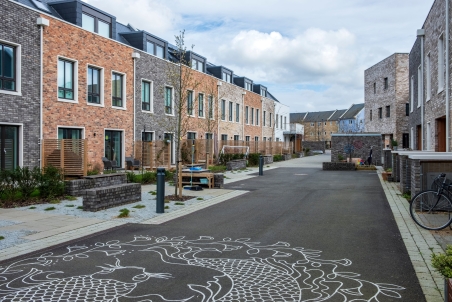
Shared surface streets are encouraged where the following conditions are met:
- Where traffic levels will be low
- Design speeds are 10mph
- Carriageway width 5m or below
- Trees, planting or SuDS in build-outs
- Block, clay or stone paver surface
- Integrated on street visitor parking where possible
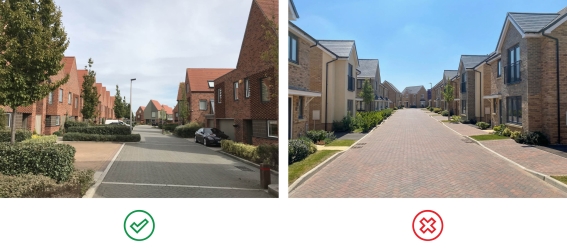
Edge Lanes are effective in enhancing connectivity within development sites, making it easier to travel around and move through sites and reducing the number of private drives and cul-de-sacs. This can substantially reduce walking distances for pedestrians and also create less need for vehicles (such as refuse collection) to turn into the street.
4.2.1.03
Home Zones (or play streets) can be successfully designed in to quieter streets within connected layouts. These are designed primarily to meet the needs of pedestrians, cyclists, children and residents.
4.2.1.04
4.2.1.05
On new developments, traffic-free play streets or corridors can be created on routes towards schools or other key community facilities.
4.3 Street design
4.3.1 Raised tables
4.3.1.01
4.3.2 Crossings
4.3.2.01
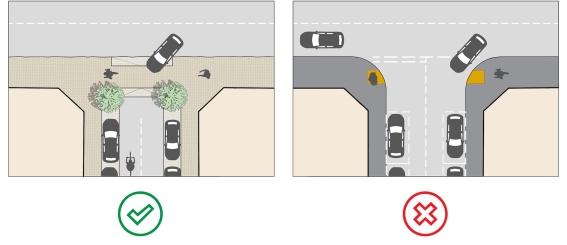
Raised crossings
- All pedestrian crossings across primary streets with high pedestrian traffic should be raised crossings.
- Raised crossings should be constructed with contrasting paving materials or colours to enhance visibility.
- All junctions between a primary street and lower-order street type should be a raised or Copenhagen crossing, where the pavement is extended across the junction.

4.3.3 Turning heads
While layouts should avoid cul-de-sacs as far as is possible, it is recognised that this is not always possible and that turning heads may be required. For example, on small and medium-sized infill sites where it is not possible to create more than one site entrance or any additional active travel routes.
This doesn't mean that conventional turning heads, with wide expanses of tarmac, are necessary or acceptable. Other approaches are possible that integrate good street design and placemaking principles.
Where turning heads are unavoidable, they are to be designed to the following requirement:
4.3.3.01
Conventional turning head patterns (hammerhead etc.) should not be used. They must be hidden and form part of squares or courtyards that have a place function too.
Characteristics to be avoided include:
- Large expanses of tarmac
- Leftover space and verges
- A shape that is unrelated to the building line
4.3.3.02
4.3.3.03
In line with turning heads being designed as public spaces, they should incorporate the following:
- Greenery
- Street trees
- SuDS
- Materials other than tarmac (some tarmac is permissible)


4.4 Walking, wheeling and cycling
Walking and cycling routes offer a healthy and sustainable mode of travel for commuting, leisure or getting to school.
4.4.1 Cycle Infrastructure
Facilities for cyclists need to be comprehensively thought out and continuous, both within the site and in connecting on to key destinations elsewhere.
Key factors to consider:
- Think of different types of cyclists: commuters (exiting the neighbourhood on a longer journey), leisure cyclists (road bikes, families on wider cycle trip), practical trips (to the shop, school, train station, town centre), children (cycling around the neighbourhood or to school or park);
- Easy to use: avoid 90 degree bends, missing sections, demarcate crossings over other streets, potential on-street parking conflicts;
- Design to be attractive to use and encourage all types of people to cycle: ‘would this cycle route design encourage me to cycle?’
4.4.1.01
These elements should be included with cycle infrastructure:
- Continuous routes where possible
- Segregated along high traffic streets and primary and secondary streets
- Minimal conflicts with side streets and driveways
- Link key destinations such as schools, parks and local centres
4.4.2 Route design
4.4.2.01
4.4.2.02
4.4.2.03
4.4.2.04
4.4.2.05
4.4.2.06
4.5 Parking
It is a priority for the council that parking be designed well and attractively, balancing parking needs with efficient use of space, high quality placemaking and adherence to the local context.
Parking requirements must be considered at the outset of the design. Insufficient and poorly designed parking can have negative impacts on how streets function, can create cluttered and chaotic environments and can create unnecessary neighbour and community conflicts and divisions.
4.5.1 Car parking principles
4.5.1.01
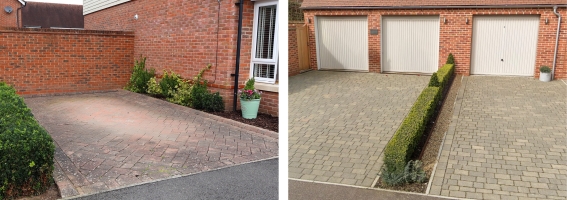
Standard parking space: 5m x 2.4m
On-street parking space: 6m x 2m
Given the approximate width of a car (including mirrors) is around 2.1m, in practice this means the total space required for driveways adjacent to a house will be about 3.3m. For double driveways, it is about 6.4m.
4.5.1.03
4.5.1.04
4.5.2 Garages and carports
4.5.2.01
Internal garage dimensions should be a minimum of:
- 3m wide and 6m deep (single)
- 5m wide and 6m deep (double)
4.5.2.02
4.5.2.03
Additional codes related to the design and materials of garages and carports is found in Chapter 7. Identity.
4.5.3 Materials
4.5.3.01
4.5.3.02
4.5.4 Parking patterns
This section includes the various permitted parking options in South Kesteven. A well-designed layout will need to use multiple types of parking.
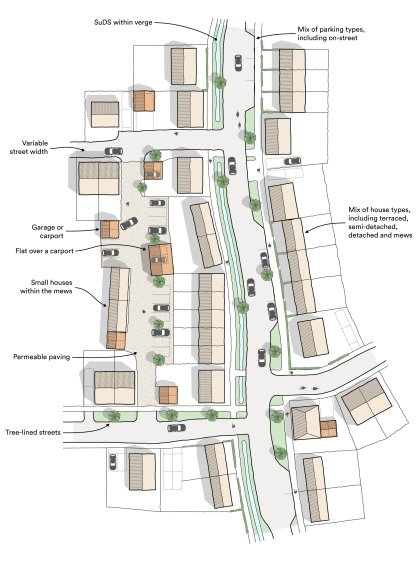

4.5.5 On-plot parking patterns
Parking on plot is usually the most appropriate type of parking in the Suburban and Village Area Types.
4.5.6 Side parking patterns
A flexible configuration suitable for detached, semi-detached or end-of-terrace homes.

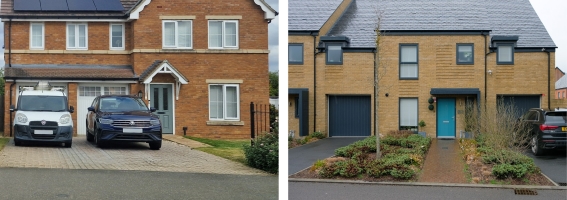
4.5.7 Front parking patterns
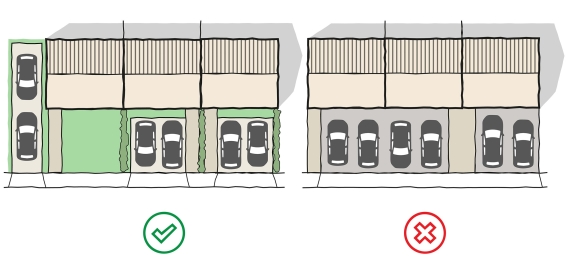
Space efficient and practical configuration which nonetheless makes it more difficult to create a high-quality, well-enclosed streetscape.
M5: Front parking requirements
- For detached and semi-detached dwellings, must be screened by a wall, railings or hedge front boundary treatment
- For detached and semi-detached dwellings, must be screened by a wall, railings or hedge front boundary treatment
- For detached and semi-detached dwellings and terraced units where possible, must not occupy entirety of plot width, with the remainder allocated for a front garden;
- End terraces must have parking at the sides if space is needed at the front for landscaping to soften the parking and for paths to access front doors.
- There must be no more than 4 spaces in a row without being broken up by landscaping.
4.5.7.02
On larger plots, it can be in the form of a front courtyard with a separate entrance and exit.

4.5.8 Corner house parking patterns
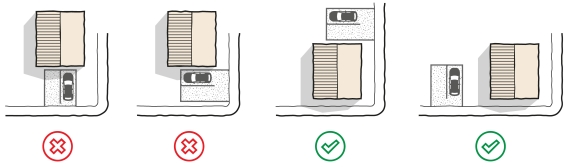
Corner parking is a practical option for corner plots.
M6: Corner parking requirements:
- A house, not the driveway or a garage/carport, must be adjacent to the junction
- Screened by a wall, railings, picket fence or hedge
- More than one driveway must not be adjacent to each other
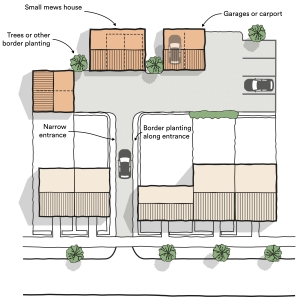
4.5.9 Courtyard parking patterns
Courtyard parking will primarily be in the middle of a block or to the rear of back gardens, though occasionally could be as a small front courtyard area.
4.5.9.01
M7: All of the courtyard parking requirements below must be met:
- Must not include more than 18 parking spaces
- Must be overlooked by adjacent homes and at least one home (or flat-over garage/FOG) fronting onto the courtyard or at least two if the courtyard includes 12 or more parking spaces
- Must include street trees, other planting and/or border planting
- Must provide access to the rear gardens or rear entrances of properties.
- Entrances must be screened either by homes or walls/hedges
- Must include a combination of parking spaces, garages, carports and mews houses
- Boundary treatment must be limestone or brick walls or hedges, not fences, following the materials codes in 7. Identity
4.5.9.03
The courtyard entrance can be accessed through a gateway or overcroft.

4.5.10 Mews parking patterns
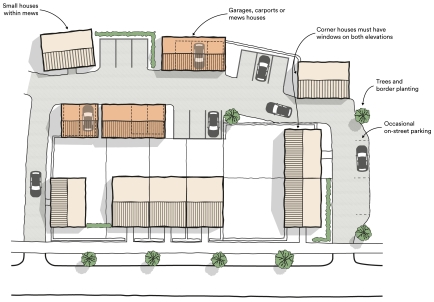
Mews streets containing homes and rear parking interlinked with the street network can be very effective, creating overlooked streets and ‘places’ rather than simply just parking areas.
M8: All of the mews parking requirements below must be met:
- If mews provides parking for adjacent homes, access must be provided to the rear gardens or rear entrances of properties
- Must include small homes, flats over garages/FOGs, carports and/or garages with at least some ground floor windows
- Must include street trees, border planting or other planting, with sufficient space given for trees to mature
- In the Village Area Type, mews must have an informal, rural character with more planting and a curved or meandering street design
4.5.10.02
Mews should:
- Have at least two entrances
- Mews longer than 50 metres should include additional pedestrian permeability.
4.5.11 Peripheral parking patterns
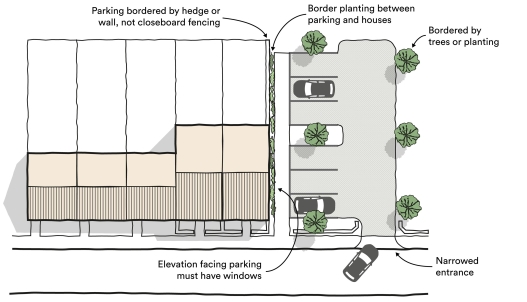
Peripheral parking are parking areas on the edge of a block or on the edge of developments. allowing for pedestrian-priority areas at the cost of a longer walk to the front door.
4.5.11.01
Peripheral parking requirements:
- Well landscaped with street trees and/or other planting
- Buildings or high quality walls (per the codes in Identity) should provide a strong built form edge to the parking area.
4.5.12 Visitor on-street parking patterns
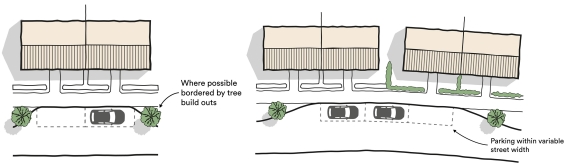
The use of on-street parking can allow for more urban streets, or act as an overflow to prevent dense developments becoming too dominated by driveways.
4.5.12.01
On-street, unallocated parking can help create orderly streets and design-out problematic pavement parking. Space for on-street parking varies depending on other parking arrangments and design components of the street. Street should be designed with the aim of providing some on-street parking. The requirements below should be met:
- A footpath should be present on the outside of the parking space to facilitate easy access to both sides of the vehicle.
- On-street parking should be broken up by street trees every 3 spaces or fewer.
- In the Village Area Type only, on-street parking should be informal, appearing as a widening of the street.
- If at a 45 degree angle, parking should only be on one side of the street

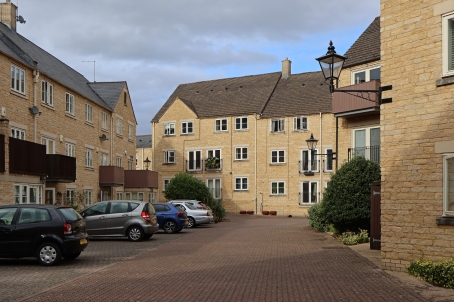
4.5.13 Parking for blocks of flats
Creating larger parking areas for blocks of flats is key to doing "gentle density" well, especially in Town Centre, Local Centre and Urban Neighbourhood Area Types.
M9: All of the parking requirements for blocks of flats below must be met:
- Car parks serving blocks of flats must be screened by buildings
- Must include street trees and border planting
- Walls that complement the building that the car park serves

4.5.14 Cycle parking
Provision of adequate cycle parking is a key driver in encouraging active travel plans will have to be submitted to detail cycle storage areas and paths.
4.5.14.01
4.5.14.02
4.5.14.03
4.5.14.04
4.5.15 Electric Vehicle (EV) charging
This code acknowledges that EV charging technology will continue to develop. This guidance applies to all new build (residential and commercial) development. The retrofitting of EV chargers or provision in the adopted highway should be discussed with officers on a case-by-case basis. Further guidance is available from Lincolnshire County Council: https://www.lincolnshire.gov.uk/roads-transport/electric-vehicles
4.5.15.01
4.5.15.02
4.6 Public transport
Access to public transport is key to providing people with choice for everyday journeys beyond their immediate neighbourhood, especially for those not able to drive. Good access to public transport helps reduce reliance on the private car.
4.6.0.01
4.6.0.02
4.60.03
