
South Kesteven Design Code Draft
Chapter 2. Context
The Council will expect to see how design proposals have been crafted in response to their context. This chapter sets out the Council's expectations for site and context analysis for planning applications of new residential development.
This chapter then sets out how we expect applicants to approach their design response to context and how to define a design vision and principles as a high level, strategic response to the site. Finally, it introduces Area Types and how to use them.
2.1 Starting with site analysis
Development does not happen in isolation. It has to respond to its surroundings in a variety of ways so one of the first things to consider before designing a development is to look beyond the red line of the application site (as well as within it). This is the site context.
Basic approach to doing a site and contextual analysis:
- Start with desk based studies: this helps plan and inform the site visit. For example: public footpaths and potential connections, topography, surrounding land uses and landscape features, official designations, local and national policies, history and historic maps.
- Visit site: study and explore the site itself, gaining access permission where required. For example: assess trees and hedgerows, key views into and from within the site, ground conditions, wet areas, ditches, wildlife activity and boundaries, including rear garden fences of adjacent properties;
- Explore around the site: views and approaches towards the site. For example, how will the site be experienced as you approach it, local buildings and streets, movement (best walking routes to schools, shops etc.), existing bus services and stops, cycle routes and footpaths. Consider existing and future residents: how might people use these areas?
- Document everything: mark the site and contextual analysis on a plan and take photographs to record everything.
- Use a checklist for consistency (see checklist in the appendix).
- Meet on site: this can be a very effective way of discussing and resolving site issues in situ.
2.2 Responding to context
Proposals should consider how to respond to the comprehensive site and contextual analysis work outlined above. This page shows examples of how development should respond to its context at the strategic level, in the early stages of design.
When reference to the local context is made in the Design Code, this refers to the historical areas of the immediately adjacent settlement, settlements (in cases where a development might straddle multiple settlements) and/or the existing landscape character.
2.3 Establishing a development vision and principles
A clear and compelling development vision is the foundation for guiding long-term growth and shaping a place’s character. This vision should articulate a shared aspiration for the site’s future, informed by community values, environmental context, and strategic goals. It provides a narrative framework that aligns planning decisions, investment priorities, and design outcomes, ensuring coherence across all development stages.
To support the vision, a set of core design principles should be defined early in the process. These principles serve as high-level criteria for evaluating proposals and guiding detailed design. They typically include:
- Contextual integration: respect and enhance the existing urban fabric, landscape, and heritage.
- Sustainability: promote low-impact, resilient design strategies that prioritize environmental performance and resilience.
- Connectivity: create a walkable, inclusive, and well-connected public realm.
- Character and identity: foster a sense of place through thoughtful architecture and public space design.
- Adaptability: encourage flexible uses and spaces that can evolve over time.
These principles ensure that development remains responsive, place-specific, and capable of delivering lasting public value.
2.4 Area Types
Following the approach set of the National Model Design Code (NMDC), this district-wide design code provides design rules based on Area Types. This code uses five Area Types to cover development typically seen in the district:
- Town Centre
- Local Centre (including village centres and high streets)
- Urban Neighbourhood
- Suburban
- Village
This reflects the variety of typologies seen throughout South Kesteven. The design code aims to pick up on the nuance between these various Area Types and, where appropriate, provide independent design instruction tailored to a specific Area Type. Where this is the case, the relevant Area Type is highlighted in bold. Key characteristics of the various Area Types are detailed in Chapter 6 - Built Form.
This code also sets out high level placemaking principles which apply to cmmercial or industrial developments which do not fall into categories.
2.4.1 How are area types allocated?
How are Area Types allocated? Area Types will be assigned by South Kesteven District Council to infill sites during pre-app discussions and will be pre-assigned to allocated sites.
- For all new medium and large developments (between 10 and 299 homes), usually only one Area Type will apply.
- Major sites (300 plus) are likely to include multiple Area Types.
C2: Aligned to this, the following standards will apply;
• If a development is within the centre of a town, an existing local centre, or along a high street, then any development must be the “Town Centre” or “Local Centre” Area Type;
• In existing towns, if a development is within a town or immediately coterminous to any other developed land use, then any development must be the “Urban Neighbourhood” Area Type;
• If the development is within an existing suburb on the edge of a town, then any development must be the “Suburban" Area Type;
• In existing villages, if a development is within or immediately coterminous to any other developed land use, then any development must be the “Village” Area Type;
• If a development is in a non-developed area, then any development must be the “Village” Area Type.
C3: Major sites of 300 homes or more, whether infill, standalone or urban extensions, must include at least two Area Types to reflect an organic pattern of density increasing towards the centre of a development, around a public or green space and along primary routes.
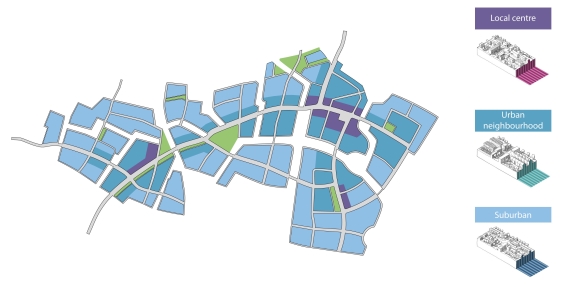
Developments which wish to take a different approach to Area Types than that described above should discuss this with South Kesteven's Development Management team during the pre-app process.
