
South Kesteven Design Code Draft
Chapter 5. Public Space
New neighbourhoods require public spaces. They are the focal point of the community. People need greenery and space on their doorstep so they can enjoy its benefits as part of everyday life. Public spaces can take the form of small village style greens, garden squares or small parks, or formal town squares. Public spaces of all sizes can provide informal settings for people to meet, rest, play, hold events and connect with nature.
The design of a public space should take account of the sun's position throughout the year, prevailing wind conditions, and the height of surrounding buildings to create a welcoming, comfortable space for people to spend time in.
5.1 Design principles
5.1.0.02
5.1.0.03
5.1.1 Scale
5.1.1.01
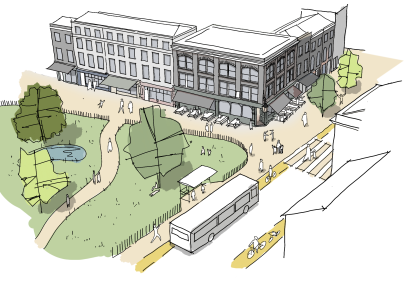
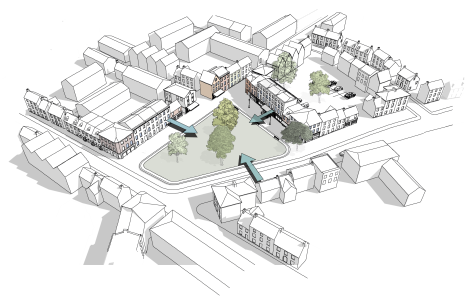
As a general rule of thumb, a public space in an urban setting, such as a square, can be smaller in scale to create the feeling of an outdoor "room".
5.1.2 Edge treatment
5.1.2.01
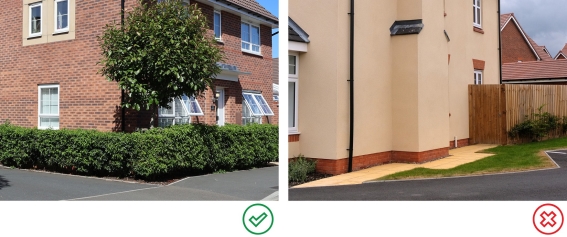
- Town Centres, Local Centres and Urban Neighbourhoods: Metal railings and/or metal railings with hedges
- Suburban: Timber post and rail fences and/or hedges
- Village: Timber post and rail fences, hedges and/or kerbs
5.2 Type and quantum
New neighbourhoods require focal points, where people will naturally gather and where amenities should be clustered. This can apply to all scales of development, from a small communal garden to a town square.
5.2.1 Local centres
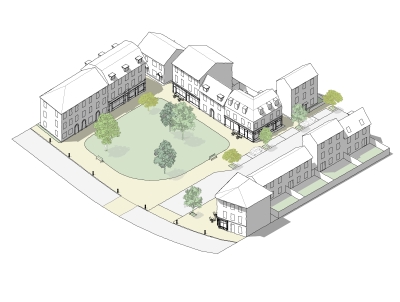
P2: A sense of community is an essential element of any new settlement. The design of local centres can take various forms (such as lining a street or set around a square) and must:
- Encourage social interaction;
- Not be car-orientated, with parking areas screened behind buildings;
- Be sensitively integrated to front public spaces or squares;
- Be exemplary in terms of design with a high quality public realm and landscaping;
- Include a mix of uses such as residential, shops and cafés, both to encourage people to stay, for socialising and for natural surveillance;
- Cater for growth in the share economy , such as car share schemes, tool and garden equipment swaps, work hubs for hot desking and remote working facilities with high speed internet;
- Be located to be walkable for as many people as possible; and
- Be co-located with other facilities such as schools and recreational areas.
5.2.2 Special places
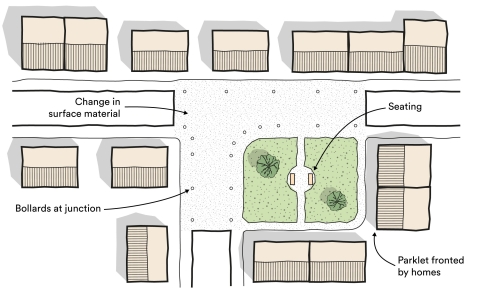
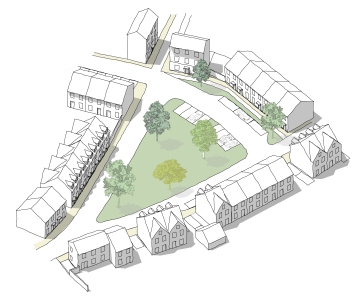
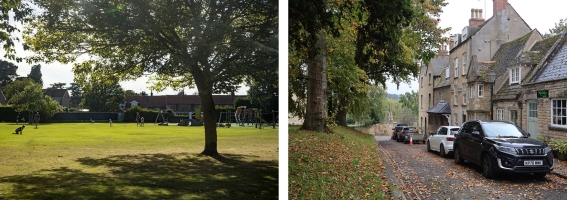
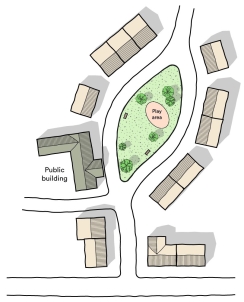
P3: As set out in Manual for Streets, residential streets have a stonger 'place' function than 'movement' function and must be designed as social spaces to include 'squares and courtyards, with associated 'pocket parks', play spaces, resting places and shelter.' (MfS 5.7.1). Special places must be created throughout a development and be a) overlooked and enclosed by buildings, and b) at intervals regular enough to prioritise the safety and needs of pedestrians and cyclists, calm traffic and reduce speeds, add character to a street, serve as wayfinding points and respond to surrounding features. A mix of the following spaces must be included, proportionate to the scale of development:
- Village greens and other open spaces
- Urban squares
- Change in surface material and street design to respond to surroundings and calm traffic
- Wider pavement with trees
- Street trees in build-outs
- Parklets
5.3 Street Furniture
Good quality street furniture can greatly enhance a sense of place and help create beautiful streets which feel well looked after. This section covers appropriate use of street furniture, signage and EV charging.
5.3.1 Seating
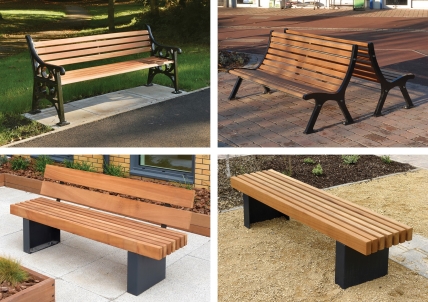
Provision of benches in new developments is encouraged to provide resting places, especially for elderly residents.
5.3.1.01
Benches should be located in areas where people will find it most comfortable to sit. This is generally at the edges of public spaces, in areas that offer shade, close to amenities, or simply somewhere with a good view. They should not back on to busy roads.
5.3.1.02
5.3.1.03
5.3.2 Bollards and railings
5.3.2.01
The use of bollards and railings in new developments should be kept to a minimum to avoid unnecessary street clutter. Where there is a need, the following codes apply:
- Plastic bollards are increasingly common in new development. These are easily damaged and should not be used.
- In the Town Centre, Local Centre and Urban Neighbourhood Area Types, metal bollards should be used.
- In the Suburban and Village Area Types, timber bollards should be used.
5.3.3 Streetlights
5.3.3.01
5.4 Services and utilities
5.4.1 Utilities structures
5.4.1.01
5.4.2 Refuse and bin storage
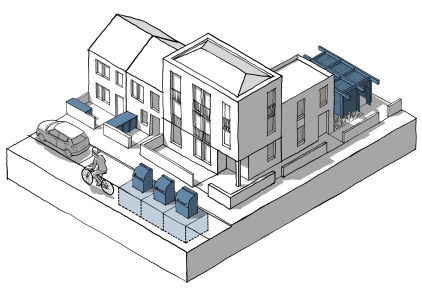
With modern requirements for waste separation and recycling, the number of household bins that need to be stored has increased. It is important that these are accommodated in ways that allow convenient access without increasing clutter or harming the appearance of buildings.
5.4.2.01
Long and convoluted bin drags (e.g. around and past adjacent rear gardens) should not be used in layouts.
Refuse collection options for new developments should be one of the options below:
- In-curtilage provision: Bin storage should be provided to the side or rear of the property (from within a rear parking area, a service alley or ginnel) or a concealed bin store provided at the front of the house or within a well-designed recessed porch.
- Communal provision: could be used as an alternative for terraced housing as well as for multi-unit housing.
5.4.2.02
Waste collection points should be no further than 30m from homes. This may be achieved with ginnels, communal provision, or by integrating storage at the front of homes. Defined bin collection points should be considered for private drives/streets.
5.4.2.03
5.4.2.04
5.4.2.05
Standalone bin enclosures should be:
- Limestone or brick (the same as permitted for homes)
- Timber (Urban Neighbourhood, Suburban and Village Area Types only)
5.4.2.06
